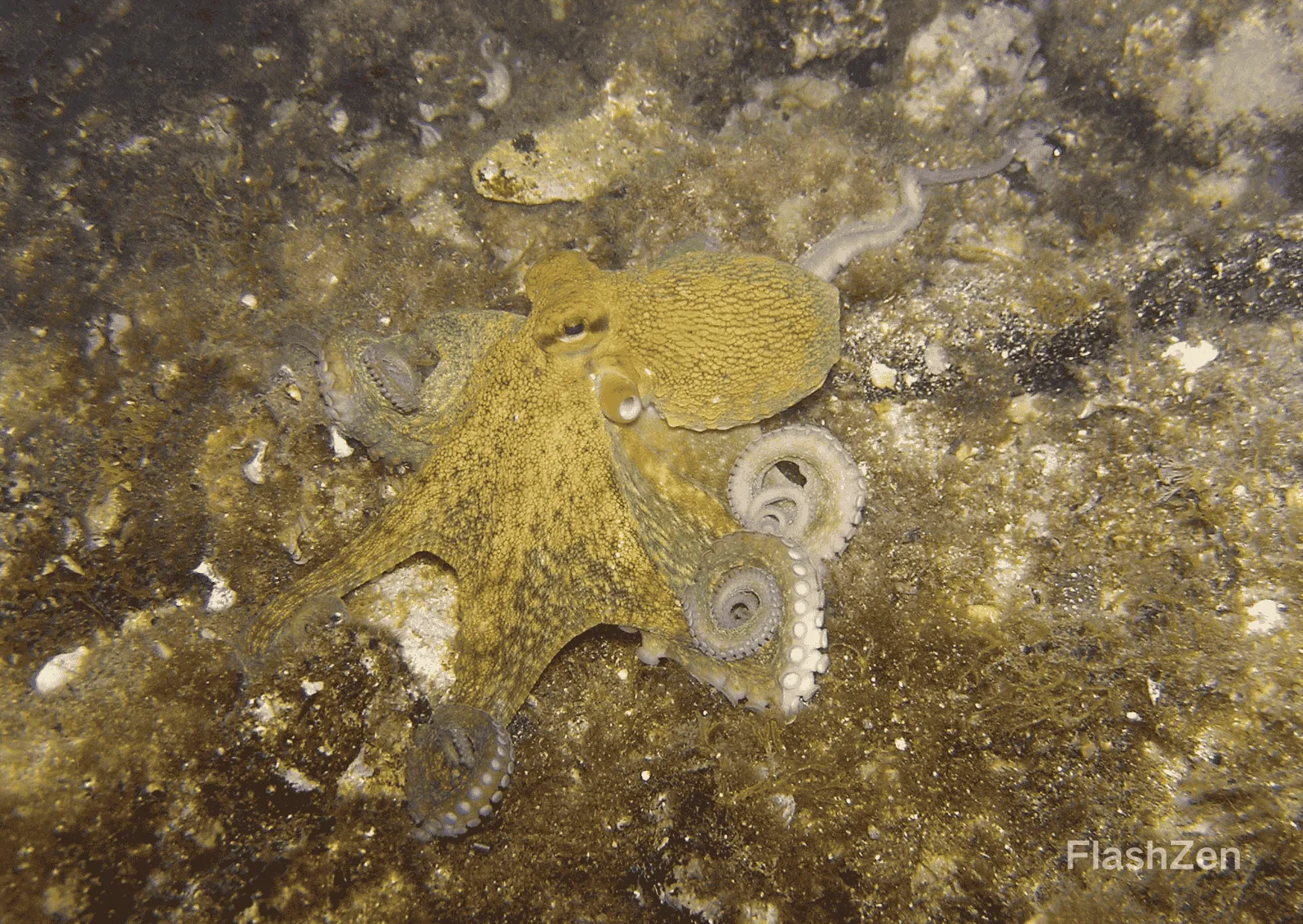
The ocean floor holds secrets in its hushed, liquid world, a realm of shifting light and shadow. Here, amidst the scattered rocks and gently undulating fronds of seaweed, a master of disguise rests. It is an octopus, a living canvas painted with the intricate patterns of the deep. Its mantle, a soft bag of intelligence, is adorned with a stunning mosaic of Tanned and umber hues, textures that mimic the rough, sediment-speckled stones it calls home. But the true marvel lies not just in its colour, but in its dynamic skin.
This is where the chromatophores perform their silent symphony. Millions of these tiny, pigment-filled sacs are under the octopus's precise neural command, allowing it to bloom with colour, fade into the background, or flash a complex pattern in the blink of an eye. As it settles onto the seabed, its skin texture even changes, becoming rough and craggy to perfectly match the surrounding geology. Its arms, powerful yet incredibly delicate, curl and explore the environment. Some of these muscular limbs are decorated with striking white spots or faint, almost luminous rings—a cryptic language we are only beginning to decipher. Are these signals meant for potential mates? A warning to predators? Or merely a byproduct of its incredible adaptive system?
The scene is one of profound tranquility, yet it buzzes with biological ingenuity. The octopus is both artist and the artwork, its body a testament to millions of years of evolutionary refinement. It breathes slowly, water flowing gently through its siphon, a quiet rhythm in the vast, silent cathedral of the sea. The surrounding detritus—a fallen shell, a dark crevice in the rock, a patch of pale sand—all become elements in its grand illusion. It doesn't just hide; it becomes the seafloor itself, a fluid creature solidifying into the landscape.
This is the secret of the chromatophores: a real-time, high-definition cloaking technology far beyond human engineering. It is a form of communication without sound, a dance of light and pigment controlled directly by the creature’s mind. Watching it, one understands that this is not a simple animal, but a complex being whose skin is a direct window into its thoughts and intentions. Every shift, every fleeting pattern, tells a story of survival, perception, and a deep, ancient connection to this hidden world. The ocean floor keeps its secrets well, but in the silent, chromatic display of this remarkable cephalopod, it offers us a breathtaking glimpse.
Chromatophore Secrets on the Ocean Floor