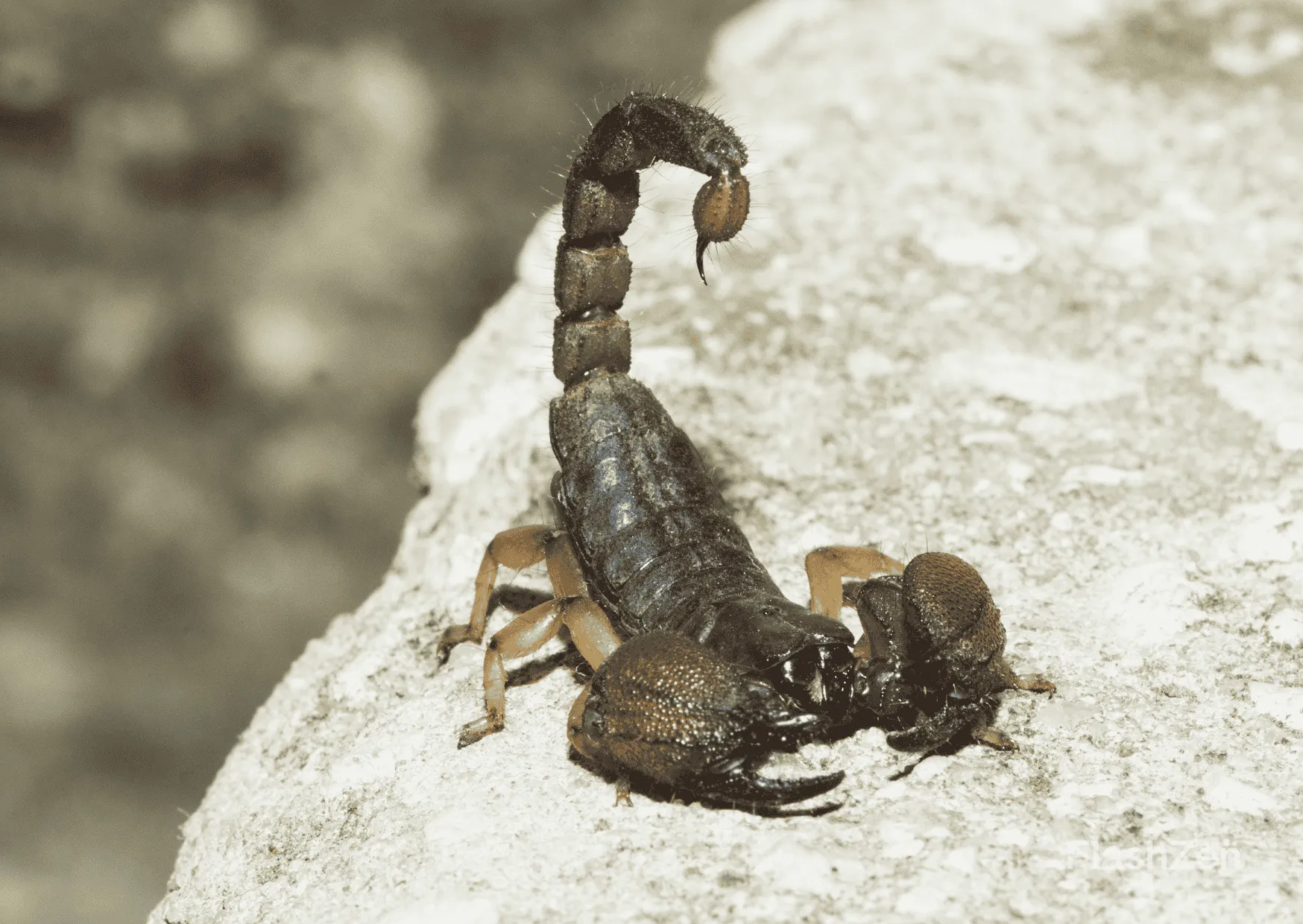
Perched upon a sun-bleached slab of stone, the scorpion is a masterclass in stillness and ancient design. Its body, a mosaic of deep browns and polished black, seems less like a living creature and more like an artifact carved from the desert itself. The pale rock, textured by millennia of wind and sand, serves as a perfect stage, its rough, granular surface contrasting with the creature's segmented, almost metallic armor. Every detail is sharp under the relentless sun: the powerful, pincer-like pedipalps held ready at the front, the row of delicate, articulated legs tucked neatly beneath its cephalothorax, and the terrifying, graceful arc of its tail, culminating in a venom-filled vesicle that glistens like a drop of dark glass.
This is not a creature of haste. It is a patient sentinel, a timeless inhabitant of a harsh world. Its low-slung profile hugs the rock, absorbing the day’s residual warmth as the air begins to cool. The shallow depth of field in the scene blurs the background into a hazy, ochre-toned dreamscape, ensuring all attention remains fixed on this formidable arthropod. It is utterly present, a concentrated essence of survival. Its light-brown claws, looking deceptively soft, are instruments of both defense and delicate manipulation, capable of sensing the faintest vibration in the stone.
There is a profound tension in its posture, a coiled potential that belies its current immobility. The famous tail, curled over its back in a predatory comma, is a promise of potency. It is a tool of last resort, a key to subduing prey and a stark warning to any who would threaten its dominion on this small patch of rock. The creature’s entire existence is a study in efficiency—every movement calculated, every ounce of energy conserved for the necessities of hunting and survival under the vast, indifferent sky.
To observe it is to look into a distant past, to a time long before mammals walked the earth. This scorpion is a relic of a primordial world, yet perfectly adapted to its modern environment. It casts a long, crisp shadow on the pale stone, a dark echo of its form that anchors it even more firmly to its chosen perch. It does not seek conflict, but it is eternally prepared for it. It is both a part of the stark landscape and its most vigilant guardian, a stoic symbol of resilience. In the deepening quiet of the desert, this sentinel remains, a dark jewel set in stone, waiting for the cover of night to begin its true work.
Desert Sentinel in Stone