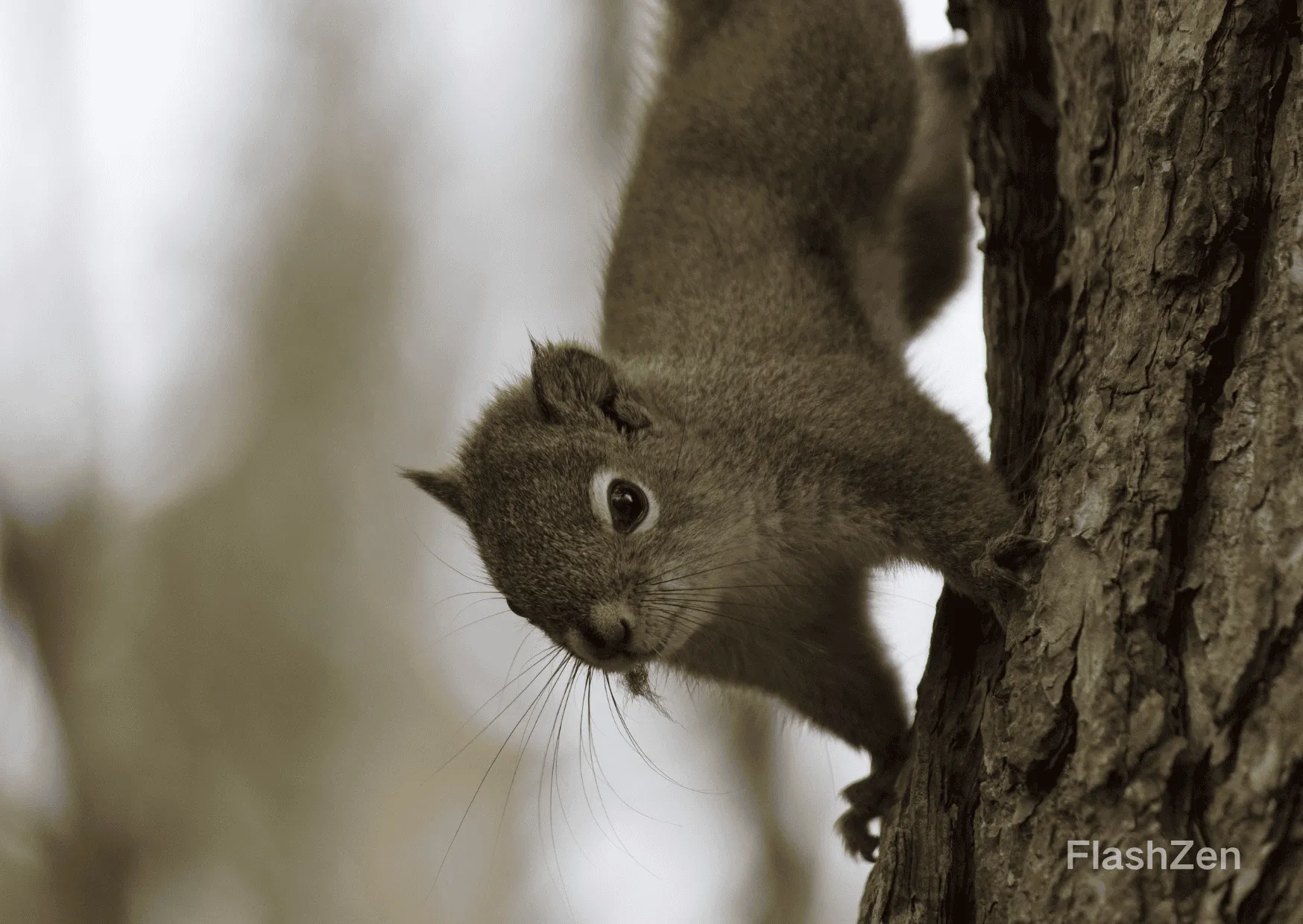
A single moment, suspended in the amber light of a late afternoon. There, on the gnarled bark of an ancient oak, a flicker of life holds perfectly still. It is a squirrel, its entire being pressed against the tree’s vertical world, a study in poised energy. The photograph, with its artfully blurred background, draws the eye inexorably to this central character, isolating him from the forest’s vastness and inviting us into an intimate encounter.
His body is a lesson in adhesion, a compact furnace of muscle seamlessly molded to the trunk’s rugged contours. The rich, russet fur of his back and flank mimics the deep browns and grays of the bark, a perfect camouflage broken only by the plume of his tail, which rests softly against the wood. But it is the head, turned fully towards the unseen photographer—towards us—that captivates. Defying the expected posture of a creature on the move, he has paused his perpetual scramble to engage in a silent exchange.
The gaze is everything. Two dark, liquid eyes, like polished beads of jet, lock onto the lens. There is no fear in them, nor outright aggression, but a profound and penetrating focus. One can almost hear the whirring of a tiny, rapid-fire mind processing data: assessing the threat, calculating distance, weighing the curiosity against instinct. A single paw is lifted slightly, fingers curled, ready to propel him into a spiraling retreat up the trunk in a heartbeat. Yet, for now, he holds. The whiskers twitch, sampling the air, and the light catches the delicate curve of an ear, translucent at its pinkish edge.
This shallow depth of field works its magic, reducing the world behind him to a soft, impressionistic wash of greens and golds. The trunk itself, however, remains in sharp, textured clarity. We can trace the deep grooves in the bark, the ridges and valleys that form his highway, the patches of silvery lichen that cling to the surface. It is a landscape in miniature, a testament to time and resilience, against which the squirrel’s fleeting life appears both fragile and intensely vital.
The overall sepia tone of the image lends a timeless, almost nostalgic quality, as if this brief meeting is a cherished secret the forest has decided to share. It is more than a portrait of an animal; it is a captured heartbeat. In that unwavering gaze, we see the wild essence of the creature—the alertness honed by survival, the boundless curiosity that drives exploration, and a spark of undeniable intelligence. The title, "Squirrel's Gaze," is perfectly apt, for it is not we who are looking at the squirrel, but rather, we who are being thoughtfully, intently, seen. The encounter leaves one with a sense of having been acknowledged by the wild, a fleeting connection made across the silent space between species.
Squirrels Gaze